Fate, Texas · TPO roofing
TPO roofing in Fate, TX
TPO is the white welded sheet on most of Fate’s newer commercial buildings, and it is what your next roof will probably be. What separates a good TPO roof from a cheap one is thickness, attachment and the details around every curb and drain.
Written for owners and property managers reading a single-ply proposal.
Single-ply membrane
TPO roofing for Fate buildings
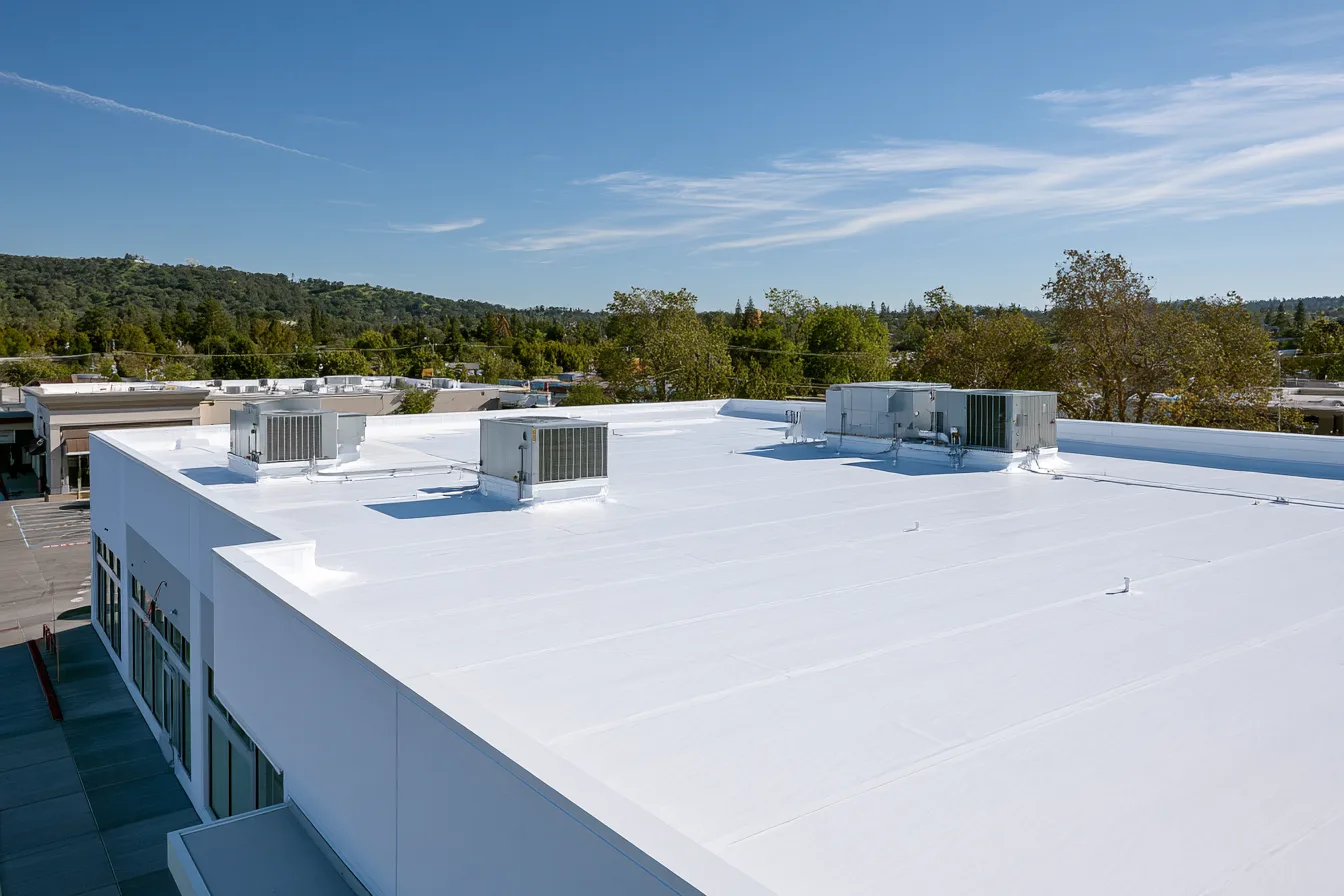
If you own or manage a building in Fate with a roof that looks flat, there is a good chance that light-colored sheet up there is TPO, or that TPO is what the next roof will be. It is the most common single-ply choice on commercial buildings today: a thermoplastic membrane, usually white, that comes in rolls and is heat welded at every seam into one continuous skin.
That is both the strength and the whole risk. A welded membrane is only as good as its welds, the insulation under it and the details around every curb, pipe and parapet. So the questions worth asking about a TPO proposal are not really about the brand on the roll. They are about thickness, attachment, what happens at the edges, and what gets left underneath the new roof.
The assembly, bottom to top
How a TPO roof is put together
A single-ply roof is a stack, and every layer in it is a line on a proposal. Knowing what each one does makes two quotes comparable.
- Deck and insulation
A steel, wood or concrete deck, then rigid insulation boards that carry the R value and, where the roof needs it, the slope. Insulation is also the layer that ruins a roof once it gets wet, which is why the condition of what is already up there drives so much of the plan.
- Attachment
Mechanically fastened means screws and plates through the membrane into the deck along the seam lines. Fully adhered means the sheet is glued across its whole face. Fastened costs less and goes faster; adhered gives a smoother surface and better performance on a tall or exposed building.
- Membrane and welded seams
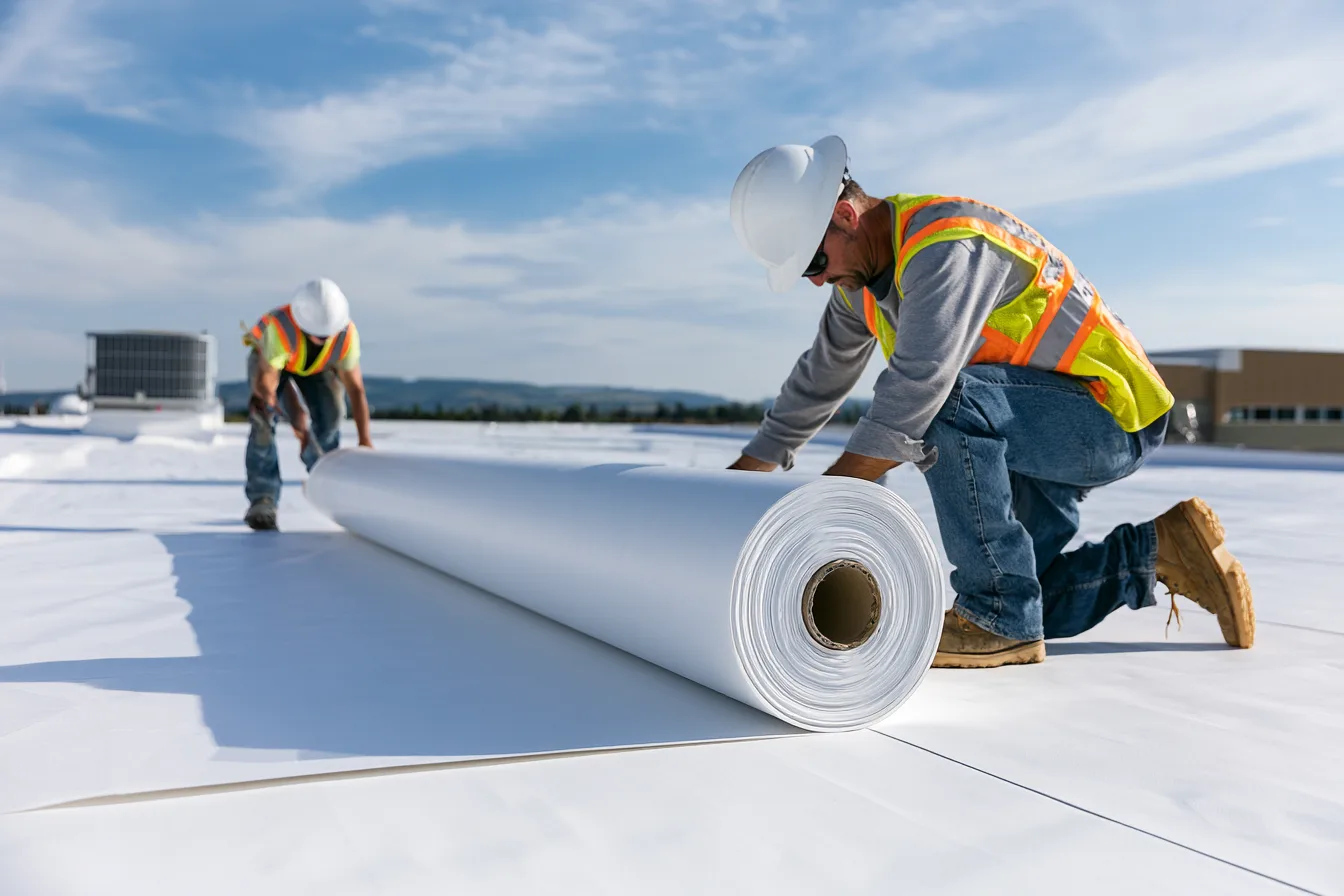
Sheets come in thicknesses, commonly 45, 60 and 80 mil. Thicker resists punctures and sun better and costs more. Seams are fused with hot air rather than glued, and a proper job includes probing those welds along their length, not just looking at them.
- Flashings, curbs and penetrations
Every rooftop unit curb, pipe, vent, drain and the parapet wall gets its own detail in the same membrane family, often with preformed corners. This is where single-ply roofs eventually leak, so it is the part of a quote worth reading twice.
- Walk pads and traffic protection
Pads along the route from the hatch or ladder to the equipment. On a roof serviced every month they are not an upsell. They are what keeps a tech from wearing a path through a 45 mil sheet.
- Edge metal and terminations
Coping on the parapet, drip edge or gutter at open edges, and the bars and sealant where the membrane stops. Wind gets under a roof at its edges first, so edge metal is part of the system rather than trim.
TPO, PVC or EPDM
Three membranes cover most low-slope buildings, and the choice is usually settled by what the building does rather than by preference. Kitchen exhaust and rooftop equipment are the two facts that decide it most often.
| Membrane | What it is | Where it fits a Fate building | What to watch |
|---|---|---|---|
| TPO | A light-colored thermoplastic sheet, heat welded at the seams, in 45, 60 or 80 mil. | Retail, office, church, school, self storage and light industrial. The reflective surface gives back a good share of a Texas August. | Weld quality and detailing decide its life. Thin membrane on a roof walked every month is a false economy. |
| PVC | Also heat welded and usually light colored, with a chemistry that resists grease, oils and chemicals. | Restaurants and anything with kitchen exhaust, plus buildings with oily or chemical rooftop discharge. | It costs more than TPO. If the building has a fryer hood it is the honest answer, and the flashings should match the field. |
| EPDM | A synthetic rubber sheet, classically black, joined with seam tape or adhesive rather than heat. | A long track record on older buildings, and still specified where a flexible dark membrane suits the roof. | Seams have always been its weak point, so seam detail and upkeep matter most. A black surface absorbs heat, which shows up in the cooling load. |
Lifespans for all three are ranges rather than fixed numbers, and the range moves more with installation quality and maintenance than with the name on the roll.
Over the old roof or down to the deck
A recover leaves the existing roof in place and adds insulation and a new membrane over the top. It saves the cost and the mess of a tear-off, and it has two hard limits. If the deck already carries two layers of roofing, or if the existing roof is water soaked or deteriorated, another cover is not permitted and the honest job is a tear-off. That is why a bidder should be looking under the roof, not only at it. Sitting between the two is restoration with roof coatings, which asks for an even drier and sounder roof than a recover does.
Recover over what is there
One layer of existing roofing, dry insulation, a sound deck and a drainage problem that tapered board can solve. The old roof stays in the assembly, the building keeps trading, and the dumpster in the parking lot stays small.
Tear off to the deck
Two layers already up there, wet insulation, a deck that needs attention, or ponding that only gets solved by starting over. It costs more and takes longer, and it is the version that leaves you a roof with nothing unknown underneath it.
What decides it
Not a preference and not a price target. A moisture survey, core cuts through the existing assembly, a layer count and a look at the deck. A proposal that recommends a recover without saying how it knows the insulation is dry is recommending a hope.
Hail, heat and rooftop traffic on a membrane
Hail on a membrane does not look like hail on shingles. There are no bald patches and no granules in the downspout. What hail does to a single-ply roof is bruise it, split it over a fastener plate or open a small puncture that behaves itself until the next long rain. Hail was reported in Fate at 1.5 inches and up to 2.75 inches on April 27, 2026, and near town on June 11, 2023, and the Fate storm history has the dates and distances. A report near your street never proves damage on your roof, but it is a good reason to have someone walk it with a camera.
That is the argument for scheduled inspections and maintenance rather than a phone call after a ceiling tile turns brown. A bruise photographed this spring is a patch. The same bruise found three years later is wet insulation and a much larger conversation.
Heat and foot traffic are the slower pair. A reflective white roof bounces back sun that a dark roof takes in, which shows up in cooling load and in how hot the deck gets in August. Whether the adopted energy code has anything to say about roof reflectance on your building is a question for the City of Fate’s building department, and the roofing permits guide points you to them. Traffic is simpler. Every trip to a rooftop unit is wear, and walk pads plus a rule about who goes up will outlast any feature on the proposal.
What to ask for in a TPO proposal
Two TPO proposals for the same building can be thousands of dollars apart and both be honest. The spread usually lives in these five lines.
Reading the quote line by line
The membrane line
Thickness in mil and the attachment method, mechanically fastened or fully adhered. When a bid comes in noticeably lower, this is often where it got lower.
The insulation and slope line
Board type and thickness, whether it is new or existing, and whether tapered insulation or crickets are included to move water off the low spots. Slope is not a detail. It is most of the roof’s life expectancy.
The details line
Flashings at curbs, pipes, drains and the parapet, edge metal, walk pads, and how the membrane terminates at each. A bid that lists membrane and insulation and then stops has left out the places roofs leak.
The documents line
Which manufacturer program, the system and installer conditions it depends on, what it excludes, and what the contractor covers for workmanship separately. Those terms belong to the manufacturer and the installing contractor, so ask to see the documents rather than the brochure.
The operations line
Access, staging, hours, tenant notice and equipment coordination. What an occupied building needs settled before the first delivery is covered on the commercial roofing hub.
Ask each bidder the same question about surprises: what happens if the tear-off finds something different, and how is that priced? A roofer who has a written answer has been there before.
TPO roofing questions in Fate
Can a new TPO roof go over my existing roof?
Often, if there is one layer up there, the insulation under it is dry and the deck is sound. Two layers or water soaked insulation and the answer is a tear-off, however the bid is worded. The way to know is a moisture survey and a few core cuts, not a walk around the parking lot.
What thickness of TPO should I be buying?
It depends on how much the roof gets walked and how exposed it sits. 45 mil is the entry point, 60 mil is the common middle for a roof with normal equipment service, and 80 mil suits heavy traffic, real hail exposure or a building you plan to hold for a long time. Thicker membrane and walk pads together still cost less than an early re-roof.
My TPO roof is only a few years old and it is leaking. Is that normal?
Young membranes rarely fail out in the open field. Early leaks almost always trace back to a detail: a curb flashing, a pipe boot, a drain clamping ring or a seam that was welded cold. That is a repair, and it is worth raising as a warranty question at the same time. Flat roof repair shows what a proper fix looks like on each system.
Would a coating be cheaper than replacing the membrane?
If the roof is dry underneath, mostly intact and draining, restoration can buy real years for a fraction of a replacement. If the insulation is wet, a coating seals the water in and you pay twice. Roof coatings explains what has to be true before that is even an option.
What should I send with a question about a TPO roof?
The address and what the building does, roughly how big the roof is, the roof type and age if you know them, what equipment sits on top, and any proposals you have already collected. If there is a leak, say where it shows up inside. From there the scope gets written on the roof, not from the parking lot.
Fate Roofing Co
Ask about a TPO roof for your building
Tell us the building, the roof size if you know it, and what has you looking at a new membrane. If a proposal is already sitting on your desk, send the questions it left you with.
(945) 307-7600