Reading a commercial roof proposal: recover, coat or replace
Three companies looked at the same building and came back with a recover, a coating and a full tear-off. Here is how to tell which one actually knows what is under the roof.
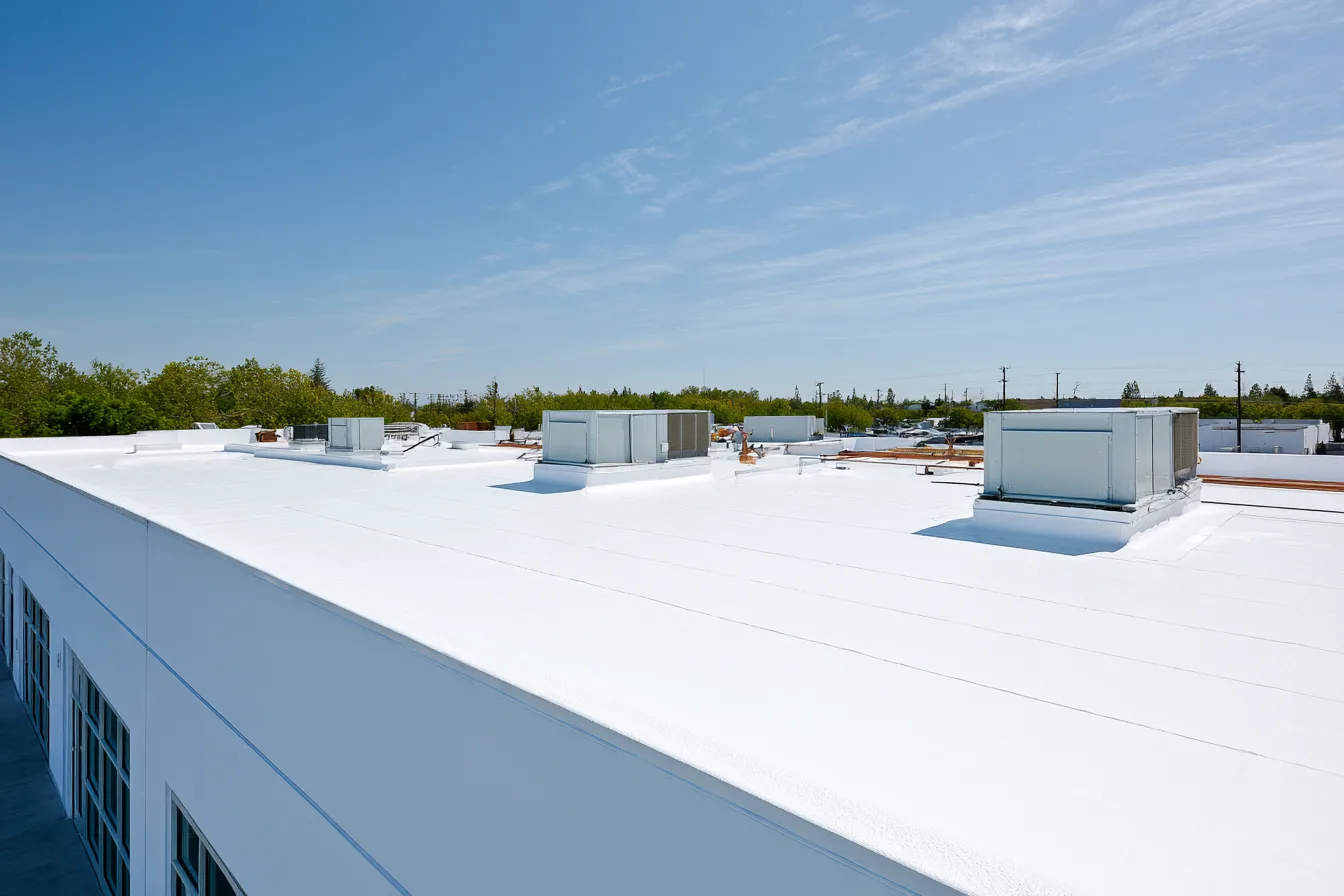
Why three proposals can disagree
You asked three roofing companies to look at the same building and got three different roofs back. One wants to go over what is there. One wants to coat it. One wants to tear it off. It feels like somebody is running a scam. Usually nobody is. What you are looking at is three different assumptions about what sits under the surface, and only one set of assumptions can be right.
Three unknowns produce most of the spread: how much of the insulation is wet, how many layers of roofing are already on the deck, and what condition the deck itself is in. None of those are visible from the surface. A bidder who cut cores and ran a moisture survey knows. A bidder who walked the roof for twenty minutes is guessing, and a confident guess reads on paper exactly like knowledge.
So the first sort is not by price. Put the three side by side and ask which one tells you something about your roof that the other two do not know.
What each option has to prove
Each recommendation carries its own burden of proof, and you can check whether it was met without being a roofer yourself.
The three options are less rivals than stages of the same roof’s life. What a roof has to be for restoration to be honest is set out under roof coatings, and TPO roofing covers what a replacement membrane involves and when a recover is still allowed. A proposal that recommends one of them without ruling out the other two has skipped the diagnosis and gone straight to the price.
- Recover: that there is one layer of roofing on the deck and that the insulation under it is dry. Another cover is not permitted over a water-soaked or deteriorated roof, or over a deck already carrying two layers. The proof is a layer count from cores plus a moisture survey, not an opinion formed from the parking lot.
- Coating: that the roof is dry, sound and draining, and that the repairs it needs are in the scope ahead of the coating. The proof is a moisture drawing with the wet areas marked, core samples, an adhesion test on your actual membrane and a stated dry film thickness.
- Tear off and replace: that the reasons are named rather than assumed. Wet insulation across the field, a deck needing work, two layers already there, or failures spreading instead of repeating. A replacement proposal should also say what changes about drainage, because starting over is the one chance to fix the low spots for good.
Questions to send back
You do not have to referee a technical argument. Send the same short list to all three and compare what comes back. The differences sort themselves out quickly, and so do the bidders.
The last question is the tell. Every commercial roof project carries some chance of a surprise under the old roof. A contractor who already has a written answer for that has done this before. One who says it will not happen is telling you they have not looked.
- How many cores did you cut, and where? What did they show for layers, insulation type and deck condition?
- Was a moisture survey done, and can I see the drawing? What does the scope do with the areas marked wet?
- What happens to the drainage? Are tapered insulation, crickets, drain work or overflow scuppers included?
- What exactly is the system: membrane type, thickness, attachment method, insulation type and thickness?
- Which details are included and which are excluded: curbs, pipes, drains, parapets, edge metal and walk pads?
- What is the warranty, whose is it, what conditions does it depend on, and can I see the document rather than the brochure?
- What happens if the tear-off finds something different from what you expected, and how is that priced?
The parts of the proposal that are not the roof
Once the systems line up, the remaining differences are usually about the building rather than the roof.
Operations first. Hours, staging, where the dumpster and the crane sit, tenant notice, how the loading dock and the customer doors stay usable, who coordinates with the HVAC contractor when units have to be lifted. On an occupied building that is not a footnote, it is a real part of what you are buying, and the commercial roofing hub covers what a plan should settle before the first delivery arrives.
Then the coverage. Manufacturer material or system coverage and contractor workmanship coverage are two different documents with two different backers and two different lengths. Read what each excludes, and read the conditions you have to keep, because maintenance and prompt reporting of damage are usually among them.
Then the exclusions on the work itself: deck repair priced by the square foot, wet insulation replacement, unforeseen conditions, permits, after-hours labor. A number that looks lower because those items sit in an allowance is not actually lower. It is just less finished, and the difference shows up as a change order in the middle of the job.
If the three still disagree after all of that, the disagreement itself is useful information about who looked and who did not. Send us the building and what the proposals say, and the next step is somebody on the roof telling you what is actually up there.