The April 27, 2026 hail in Fate: how to check your roof now
Hail came through Fate on the evening of April 27, 2026. Months later, plenty of roofs here have still never been looked at. Here is what the record actually says, what stones that size do to a roof, and what you can check yourself without leaving the ground.
What the record says
NOAA’s storm database holds several reports from Fate and the streets around it that evening. Hail was reported in Fate at 1.5 inches, and a second Fate report, logged 0.8 miles from the town center, put the stones at up to 2.75 inches. Blackland, about a mile and a half from that same point, reported 2 inches. Just south of Rockwall an amateur radio operator reported 1.75 inches. The report logged at 2.75 inches carries a note that the exact size was never measured; the observer judged it by the holes the stones left in a metal roof on a property near the Brookshire’s.
The National Weather Service office in Fort Worth summarized the day as supercells producing numerous reports of large hail, up to teacup size, across North Texas, with the largest hail reported in northeast Dallas, Rockwall and Hunt counties.
Read all of that for what it is. These are observations of where hail fell and how big somebody judged it to be, pinned to a point on a map. They do not draw a line around the roofs that were damaged, and a report a few streets away neither proves your shingles took a hit nor proves they did not. What the record does establish is that stones easily large enough to hurt an asphalt roof came down in this town that night. The Fate storm history lists every reported hail and wind event near the middle of Fate by date, so you can see how your own address lines up with April 27 and with the other storms behind it.
What hail that size does to a roof
Functional damage to asphalt shingles generally starts around the one inch mark, which is also the size at which the Weather Service calls a thunderstorm severe. Every size reported in Fate on April 27 was above that line, and the larger reports were well above it.
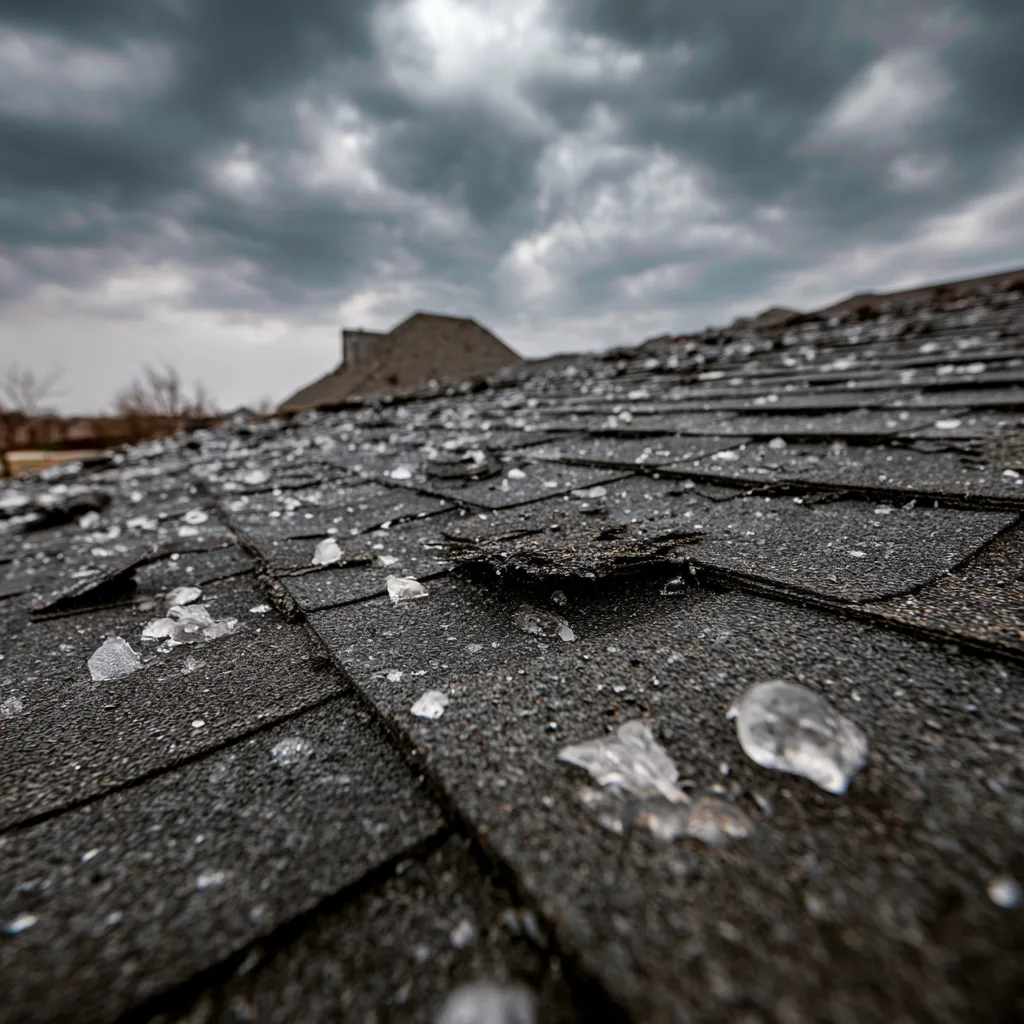
An asphalt shingle is a layer of granules over an asphalt-saturated mat: the granules are the armor, the mat is the structure. Hail works through them in stages. First the granules come loose, which is why gutters fill with what looks like coarse sand after a storm. Scattered granule loss is usually cosmetic. Loss that opens up the black mat is not, because bare mat bakes in the sun and ages fast.
The damage that decides most claims is underneath. A stone can compress the shingle hard enough to fracture the fiberglass mat while the surface still looks intact, like a bruise on an apple. That bruise feels soft under firm thumb pressure, and it is why hail damage is so often invisible from the driveway. Bigger stones, or older and more brittle shingles, crack and split straight through, and around two inches punctures become possible.
Soft metal is the honest witness on the ground. Gutters, downspouts, vent caps and the fins on the air conditioning unit dent at hail sizes that also bruise shingles. Dents there are often treated as cosmetic on a claim, but they tell you the hail that fell on your lot was big enough to take seriously.
What you can check without a ladder
Stay off the roof. A wet or hail-scuffed slope is slick, walking on bruised shingles can make the damage worse, and nothing you would learn up there is worth a fall. Everything below can be done from the ground or from inside the house.
If two or three of these turn up, that is a reason to have a proper roof inspection done, with photographs, before the next round of spring storms adds another layer to the story. None of these checks is a diagnosis, and a clean walk around the house does not rule hail damage out. Mat bruising is confirmed by hand on the roof, not by eye from the yard.
- Walk the gutter line and look for piles of granules where the downspouts drain out. A little grit is normal; a heap of it after one storm is not.
- Look at everything soft and metal: gutter faces, downspouts, vent caps and hoods, the AC condenser fins, the mailbox, a metal shed or fence panel.
- Step back to the street and look across each slope with the sun low. Dark speckles or bare patches where granules were knocked away read more clearly in raking light than at noon.
- Check the ridge line and the edges for shingles that look lifted, creased or missing. Wind on the same night can break the seal strip even where hail did nothing.
- Go into the attic with a flashlight on a dry day. Look for daylight around vents, dark staining on the decking or rafters, damp insulation, or a rusty ring around a nail. Then look at the ceilings below, especially under a valley or beside a chimney. A stain that first appeared after April is worth tracing back to the roof.
Why the calendar matters
Two separate clocks run after a hail storm, and they run at different speeds.
The first is your insurance policy. Reporting deadlines for storm claims are set by the policy itself rather than by a single statewide rule, and they vary from one carrier and contract to the next. Some are shorter than people expect, and a missed window can end a claim that would otherwise have been paid, so read your declarations page or call your agent and ask what your notice period is for wind and hail. The roof insurance guide explains how the rest of it works: replacement cost against actual cash value, the separate wind and hail deductible, and what an adjuster weighs on the roof. That is general information rather than legal advice, and your policy language governs.
The second clock is physical, and it does not care whether you file anything. A bruised shingle is a shingle with a shortened life. A cracked one lets water reach the underlayment, and from there it finds the decking, the insulation and eventually a ceiling. Damage that would have been a contained repair in May can be a wet-decking repair by the time it announces itself, and by then the storm is old enough that the argument over what caused it is much harder to win.
If your roof has not been looked at since April 27, the useful next step is not a decision. It is a documented look with dated photographs, so you know whether you are dealing with a repair, a claim or nothing at all. Plenty of Fate roofs came through that night fine, and finding that out is a perfectly good outcome.